
Midwest Hospital planned to expand and potentially replace its ED in response to increased crowding and congestion. Although the current number of annual visits (40,000) was not expected to grow significantly in the near future, the patient and visitor waiting room was frequently overflowing during the evening hours. ED staff also began creating “hall beds” by labeling and assigning defined stretcher bays in the hallways to gain additional treatment space during peak periods. The relocation of an adjacent occupational medicine clinic was viewed as an option for ED expansion in lieu of total ED replacement.
Specific facility expansion goals included expanding the patient and visitor waiting space with enhanced amenities; providing adequate exam and treatment space; triaging nonurgent patients in a separate, fast-track area; and developing a holding area for patients to be admitted who are waiting for an available inpatient bed. Although facility expansion and operations improvement were deemed necessary by all members of the planning team, the CFO was concerned about spending significant capital dollars when ED revenues were relatively flat. ED staff were also not in agreement regarding the extent of required expansion; some wanted to almost double the size of the current ED, while others were concerned that significant expansion would require additional staff at a time when budgets were tight and recruiting was difficult. Others were concerned about the long ED length of stay and its impact on customer satisfaction. However, all members of the planning team agreed that a detailed analysis of the relationship between improvements in exam and treatment room turnaround time and resulting space need and construction cost was warranted prior to initiating the detailed operational and space programming process.
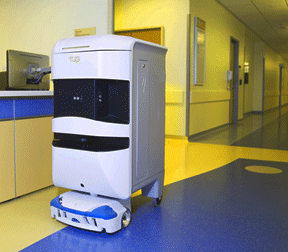 The autonomous mobile TUG robots, developed by Aethon, work 24/7 to deliver drugs, laboratory specimens, supplies, linens and meals and cart away medical waste, soiled linens and trash at a variety of medical centers throughout the U.S.
 Every day, all around the world, hospital staff turn to a transport network that the Internet and the latest Silicon Valley wizardry cannot match — the pneumatic tube system. Designed primarily to move paper, this cutting edge technology in the 19th century drove commercial businesses — such as postal services and department stores — whose physical size demanded something faster than standard human pace. With the arrival of the Internet, pneumatic tube systems lost their value for many industries. But this technology not only endures — but thrives — in hospitals, particularly with the introduction of wider diameter containers and use of air flow to slow down the containers for a soft landing at their destination stations so to avoid damaging sensitive lab samples.