
Ocean Health System includes three acute care hospitals with a total capacity for 670 beds although each hospital staffs significantly less beds:
- Valley Hospital with 245 beds
- Coast Hospital with 360 beds
- Rural Hospital with 65 beds
Valley Hospital and Coast Hospital are located six miles apart in a scenic northeast region. Acute care beds are currently located at both sites along with duplicative emergency departments, surgical suites, and various diagnostic and support services. Both of these facilities share essentially the same market along with a competitor hospital to the northeast.
Rural Hospital, although only eight miles away from Valley Hospital, requires travel via a congested and winding road with the travel time averaging between 20 and 30 minutes. Rural Hospital also has a distinctly different patient catchment area than Valley and Coast Hospitals. Most of Rural Hospital’s patients come from the west where it competes with hospitals bordering a large urban area.
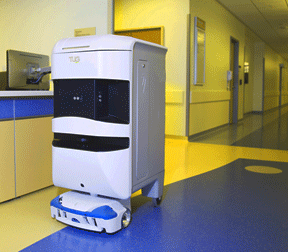 The autonomous mobile TUG robots, developed by Aethon, work 24/7 to deliver drugs, laboratory specimens, supplies, linens and meals and cart away medical waste, soiled linens and trash at a variety of medical centers throughout the U.S.
 Every day, all around the world, hospital staff turn to a transport network that the Internet and the latest Silicon Valley wizardry cannot match — the pneumatic tube system. Designed primarily to move paper, this cutting edge technology in the 19th century drove commercial businesses — such as postal services and department stores — whose physical size demanded something faster than standard human pace. With the arrival of the Internet, pneumatic tube systems lost their value for many industries. But this technology not only endures — but thrives — in hospitals, particularly with the introduction of wider diameter containers and use of air flow to slow down the containers for a soft landing at their destination stations so to avoid damaging sensitive lab samples.
 For several decades, healthcare organizations have been developing Centers of Excellence to better compete for market share, research dollars, philanthropy, and scarce subspecialists. Promoting a specific program within the healthcare organization’s broader portfolio of services helps to attract the critical mass and resources required to make it successful. Centers of Excellence are commonly developed for cardiac care, cancer treatment, neurosciences, orthopedics, pediatrics, and women’s health, although various other clinical programs and specialties may also be candidates. Historically, these centers were envisioned as freestanding facilities with the name prominently displayed on the building’s facade. Before high-speed internet and intranet connections, this concept was promoted to improve collaboration and communication among the healthcare providers as well as to provide one-stop-shopping for the customer.