
Case Study: Planning an Ambulatory Care Facility

Prudent Health System planned to construct a new ambulatory care facility on its main hospital campus to provide space for urgent care, ambulatory surgery, and various hospital-sponsored clinics. The organization needed space to accommodate the following ten-year workload projections and corresponding clinical services:

  • Urgent care center with 32,000 annual visits
  • Ambulatory surgery center with 4,200 annual surgical cases
  • Hospital-sponsored clinics: medicine (23,000 annual visits), surgery (15,000 annual visits), neurosciences (6,000 annual visits), orthopedics (16,000 annual visits)

In addition, Prudent Health planned a small express testing area to consolidate routine, quick-turnaround outpatient testing in a single area — including X-ray, electrocardiogram, and specimen collection — along with a small satellite laboratory.
Read more

Case Study: Evaluating Emergency Expansion

Midwest Hospital planned to expand and potentially replace its ED in response to increased crowding and congestion. Although the current number of annual visits (40,000) was not expected to grow significantly in the near future, the patient and visitor waiting room was frequently overflowing during the evening hours. ED staff also began creating “hall beds” by labeling and assigning defined stretcher bays in the hallways to gain additional treatment space during peak periods. The relocation of an adjacent occupational medicine clinic was viewed as an option for ED expansion in lieu of total ED replacement.

Specific facility expansion goals included expanding the patient and visitor waiting space with enhanced amenities; providing adequate exam and treatment space; triaging nonurgent patients in a separate, fast-track area; and developing a holding area for patients to be admitted who are waiting for an available inpatient bed. Although facility expansion and operations improvement were deemed necessary by all members of the planning team, the CFO was concerned about spending significant capital dollars when ED revenues were relatively flat. ED staff were also not in agreement regarding the extent of required expansion; some wanted to almost double the size of the current ED, while others were concerned that significant expansion would require additional staff at a time when budgets were tight and recruiting was difficult. Others were concerned about the long ED length of stay and its impact on customer satisfaction. However, all members of the planning team agreed that a detailed analysis of the relationship between improvements in exam and treatment room turnaround time and resulting space need and construction cost was warranted prior to initiating the detailed operational and space programming process.

Read more

Rethinking the Intensive Care Unit

Many hospitals feel that they never have enough intensive care beds and are constantly pressured to expand existing units or create new units. Historically, intensive care units (ICUs) have provided intensive observation and treatment of patients in unstable condition. Because of the high-tech requirements and highly skilled staff, these units are expensive to build and operate. Insufficient intensive care beds also affects the ED, as high-acuity patients waiting to be admitted backup in the ED when the ICUs are full.

Read more

Vascular Centers Are Addressing an Unmet Demand

Historically, hospitals have focused on growing their cardiology programs and services that treat atherosclerosis, or hardening of the arteries, and other heart conditions. However, it is becoming increasingly evident that programs to address systemic vascular disease ― cerebrovascular, carotid, aortic, and peripheral vascular are needed to address a growing and unmet need. The National Institutes of Health (NIH) reports that non-coronary vascular stenosis and arterial breakdown is a prevalent disease in the United States. Up to 12 million people are estimated to have peripheral arterial disease (PAD) compared to the same number (12 to 13 million) with coronary artery disease (CAD). With the emphases on CAD as a serious health problem in the U.S., vascular disease is more often under-diagnosed and as a result is frequently under-treated.

Read more

TUG Robot Is Working Harder Than Ever

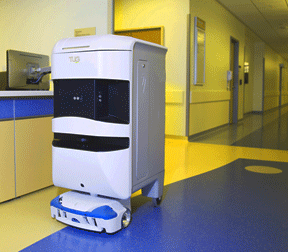
TUG RobotThe autonomous mobile TUG robots, developed by Aethon, work 24/7 to deliver drugs, laboratory specimens, supplies, linens and meals and cart away medical waste, soiled linens and trash at a variety of medical centers throughout the U.S.

The TUG robot has a map of the hospital stored in its memory and uses a scanning laser and 27 infrared and ultrasonic sensors to detect and model the environment in real time to maintain accurate position and avoid obstacles. It stands back from elevators and summons them through the hospital’s wireless network, using radio waves to open doors. It even audibly speaks while performing its tasks and automatically returns to its charging dock after completing a delivery. The UCSF Medical Center is deploying a fleet of about two dozen TUG robots at its new state-of-the-art hospital at Mission Bay in San Francisco and TUG robots are installed at 35 VA hospitals.

This article is an update of a previous post.

See the TUG robot in action.

What 19th Century Technology is Still Thriving Today?

Pneumatic TubesEvery day, all around the world, hospital staff turn to a transport network that the Internet and the latest Silicon Valley wizardry cannot match — the pneumatic tube system. Designed primarily to move paper, this cutting edge technology in the 19th century drove commercial businesses — such as postal services and department stores — whose physical size demanded something faster than standard human pace. With the arrival of the Internet, pneumatic tube systems lost their value for many industries. But this technology not only endures — but thrives — in hospitals, particularly with the introduction of wider diameter containers and use of air flow to slow down the containers for a soft landing at their destination stations so to avoid damaging sensitive lab samples.

Read more